


10 best-selling commercial vans and what they're good at
Oct 27, 2026 5 min
Prices shown incl. VAT Prices are shown excluding VAT where VAT is deductible.
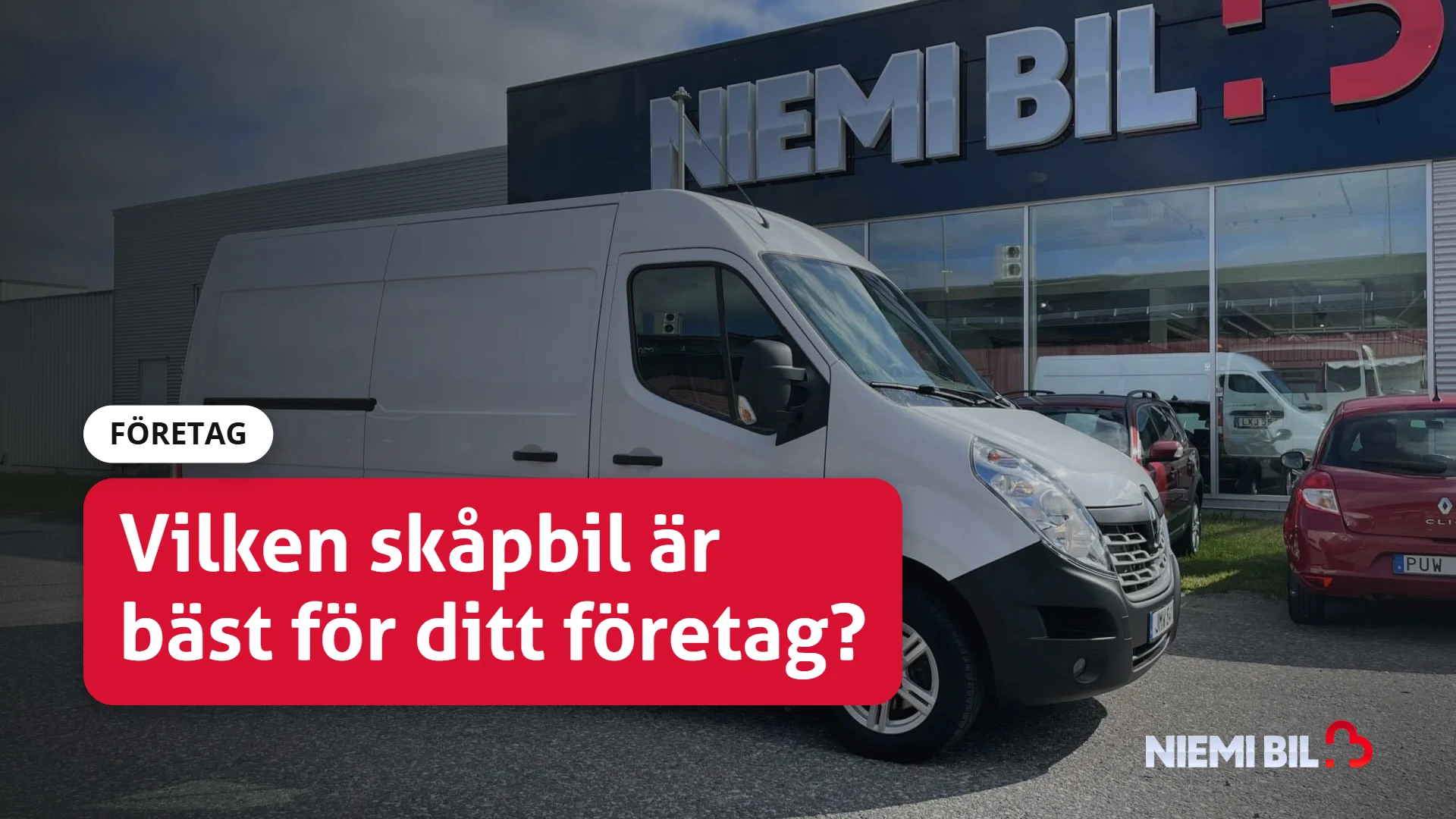
The best van is not the biggest or the most expensive. It's the one that can accommodate a normal workday, and no more.
Three measurements determine almost everything. Here they are, and how to use them to make the right choice.
Want to see what's in stock? Here are all our used vans with deductible VAT.
| Small | Medium | Great | |
|---|---|---|---|
| Cargo volume | Approximately 3–4 m³ | Approximately 5–9 m³ | Approximately 10–18 m³ |
| Maximum load | Often 500–1,000 kg | Often 900–1,300 kg | Often 1,000–1,500 kg |
| Whole building boards | Rarely | In long version | Yes |
| Standing height | No | No | Often |
| Driving license | B | B | B or C1 |
| Fits | Service and assembly | Most craftsmen | Construction, moving and bidding |
The figures are approximate and vary between models, wheelbases and roof heights. Always check the details in the registration certificate.
A small van drives almost like a car. It fits in a regular parking space and handles well in city traffic.
If you load mostly tools, assortment boxes and spare parts, it will last a long time. Many models are also available in a longer version with an extra cubic meter.
It is also the cheapest size to buy, fuel and service.
Electricians, plumbers, locksmiths and service technicians – everyone who has many short stops a day.
✓ Our conclusion
If the job can fit in a small van, there is rarely a reason to pay for a larger one.
The mid-size van, for example Volkswagen Transporter or Ford Transit Custom, is the most common size among used transport trucks. It is large enough for most purposes, but still easy to drive.
With a long wheelbase, you can often fit entire building boards between the rear doors and the partition wall. Please measure yourself before purchasing to make sure you have enough space for what you are shipping.
The cabin often has three seats, and the comfort is sufficient for long days on the road.
Carpenters, painters, floor layers and ventilation installers who need space for both materials and tools.
✓ Our conclusion
Unsure about the size? A mid-size van in a long version is the safest choice.
Large vans come in several lengths and roof heights. The tallest ones allow you to stand upright in the cargo area. They are also often available with a flatbed, almost like a pick-up, which is a convenient way to load and transport more durable, weatherproof materials or debris and trash.
Look at the total weight first. Up to 3,500 kg, a B driving license is sufficient, above that, a C1 is required. The same model can be available in both versions.
A large van will take more fuel and cost more. It pays off when you fill it up, not when it's driving around half empty.
Construction companies with a lot of material, moving companies, courier companies and anyone who drives pallets.
✓ Our conclusion
Buy a large van for the regular week, not for the only moving load of the year.
Electric vans are available in all three sizes. They are quiet, emit no exhaust fumes and have fewer wearing parts than a diesel.
They are best suited when the day's driving is predictable and the car can be left charging every night.
The range decreases in cold weather and with a heavy load. Read how it worked for a business owner in Pajala: an entire winter with an electric transport truck in Norrbotten.
Craftsmen and service companies that mostly operate within a city or region, and courier companies with fixed routes.
✓ Our conclusion
If you know how far you drive each day and can charge, electricity is often the cheapest in the long run.

Based on a typical work week: the longest and heaviest load you carry. Most tradesmen can get by with a medium-sized van in a long version.
Yes, if the total weight is no more than 3,500 kg. This applies to most small and medium-sized vans and many large ones.
Cargo volume is how much space is available, in cubic meters. Maximum load is how much the car can carry in kilograms. A large car can have a lot of volume but still have a limited maximum load.
L stands for length and H for height. An L2H2 is therefore longer and taller than an L1H1 of the same model. Exact dimensions differ between brands.
On a used van, maintenance matters more than the make. Choose a car with a documented service history and check the clutch, brakes and suspension for wear.
Yes, but the range will be shorter in cold weather. Preheat the car while it is charging. Read about a winter with an electric delivery truck in Norrbotten.
The van has more protected cargo volume and is cheaper to operate. The pickup wins if you tow heavy trailers or drive a lot off-road.
If the car is registered as a light truck, is sold with VAT and is used in VAT-taxable activities – as a rule, yes. Check with your accounting consultant.
Popular small vans are the Volkswagen Caddy, Ford Transit Connect, Peugeot Partner and Toyota Proace City.
Popular mid-size vans are the Volkswagen Transporter, Ford Transit Custom, Mercedes-Benz Vito and Renault Trafic.
Popular large vans are the Mercedes-Benz Sprinter, Volkswagen Crafter and Renault Master.
Popular electric vans are the Volkswagen ID. Buzz Cargo, Ford E-Transit Custom and Mercedes-Benz eVito.
Do you know what size you need? See all our used vans with deductible VAT, or the entire range of transport trucks.
Oct 27, 2026 5 min
Oct 27, 2026 5 min
27 Oct 2026 8 min