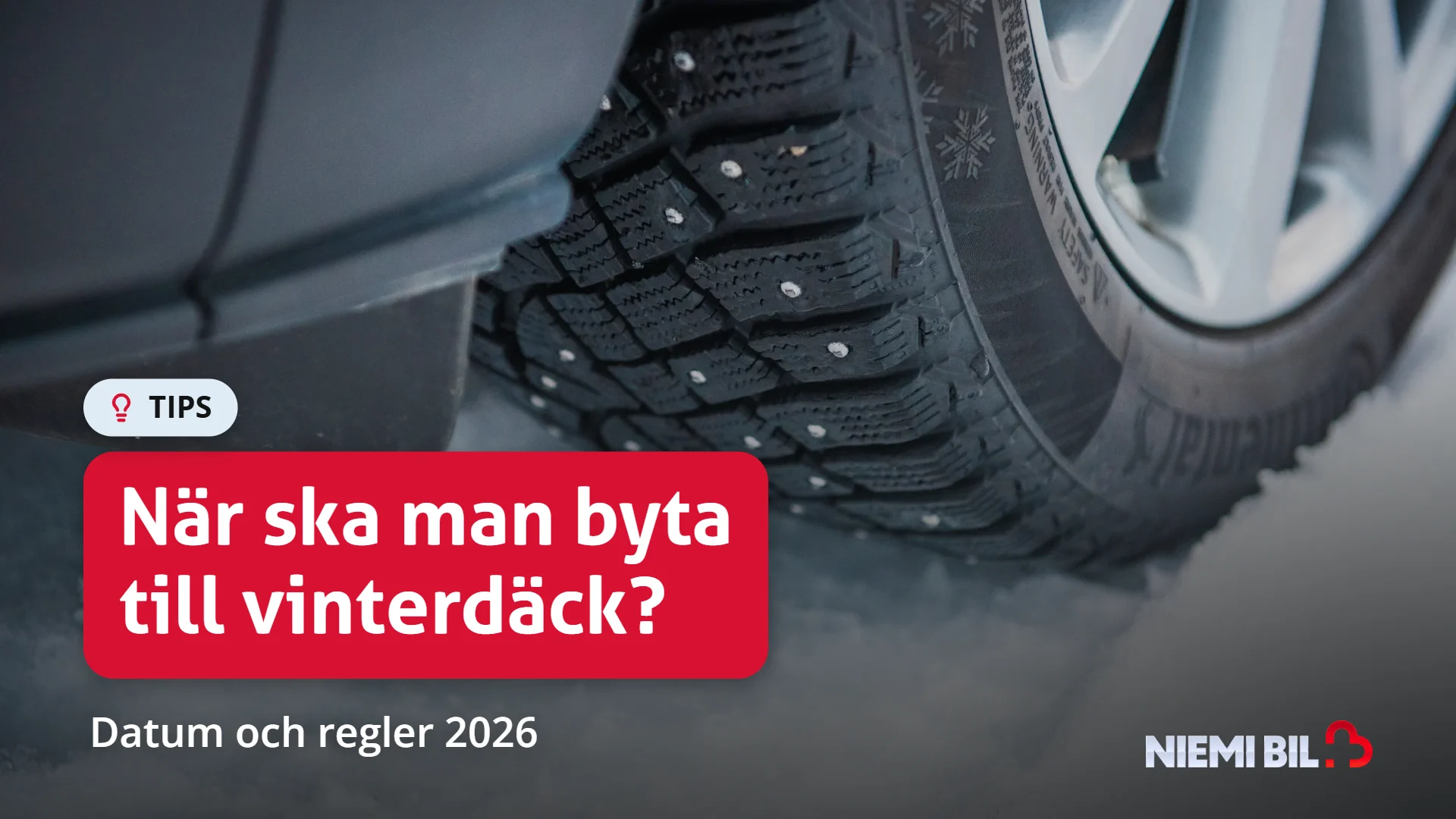
The first frost has arrived, but the summer tires are still in place. Do you need to change them now, or can you wait until December?
The rules for winter tires and studded tires have different dates, and the weather doesn't care about either of them. Here's what applies and when it's smart to change.
Summary
Winter tires are mandatory from December 1 to March 31 when there are winter road conditions.
You can drive with studded tires from October 1 to April 15., and also outside that period if there are or may be winter road conditions.
The tread depth should be at least 3 mm. on winter tires during the winter period. We recommend at least 5 mm.
Change when the nights start to get cold, not when the law says so. In northern Sweden it is often already in October.
The dates you need to keep track of
Rule
Date
Studded tires allowed
October 1 to April 15
Requirements for winter tires in winter road conditions
December 1 to March 31
Studded tires outside the period
Allowed in winter road conditions
Some municipalities have a ban on studded tires on individual streets. Check what applies where you live.
Do I have to have winter tires on December 1st?
The requirement only applies when there are winter road conditions, i.e. snow, ice, slush or frost on the road. If it is winter road conditions and you have summer tires, you may receive a fine.
The requirement applies to passenger cars, light trucks and light buses. The tires must be labeled as winter tires.
When is it smart to switch?
The law says December 1st, but the weather decides. Summer tires become hard and lose grip even at low temperatures, long before the snow comes. Some rules of thumb:
Change when the average daily temperature is around 7 degrees or lower.
Change before the first frost night. In Norrbotten and Västerbotten, it often arrives as early as the end of September.
If you are going north or over the mountains: change before you go.
Make an appointment well in advance. Tire shops get busy when the first snow arrives.
Studded tires or friction tires?
Studded tires grip best on ice and are most common in the north. Friction tires, i.e. studless winter tires, are quieter, wear less on the road and work well on snow and salted roads.
The legal requirement is 3 mm on winter tires. during the period December 1 to March 31. We recommend at least 5 mm, as grip on snow and slush is significantly worse when the tread is shallow. For summer tires, the requirement is 1.6 mm.
Only if there are or may be winter road conditions. Otherwise, October 1st applies.
What happens if I have summer tires in winter road conditions in December?
You may be fined. The requirement for winter tires applies from December 1 to March 31 when there are winter road conditions.
Can I drive with studded tires after April 15?
Yes, if there are or may be winter road conditions, for example in the mountains. Otherwise, you should switch to summer tires.
Can I drive with winter tires in the summer?
Studded tires are not allowed in the summer. Friction tires are not prohibited, but they provide longer braking distances on hot asphalt and wear out faster.
How much tread depth should winter tires have?
At least 3 mm by law during the winter period. We recommend at least 5 mm for good grip on snow and slush.
Where can I change to winter tires?
With us you can book a wheel change, buy new winter tires and store your tires. Read more at our tire page.
Dags för hjulskifte?
Boka hjulskifte, köp nya vinterdäck eller förvara dina däck på däckhotell.
To provide a good experience, we use technologies such as cookies to store and/or access device information. When you consent to these technologies, we may process data such as browsing behavior or unique identifiers on this website. If you do not consent or if you withdraw your consent, this may adversely affect certain features.
Functional
Always active
The technical storage or access is absolutely necessary for the legitimate purpose of enabling the use of a specific service expressly requested by the subscriber or user, or for the sole purpose of carrying out the transmission of a communication over an electronic communication network.
Alternative
The technical storage or access is necessary for the legitimate purpose of storing settings that are not requested by the subscriber or user.
Statistics
The technical storage or access used exclusively for statistical purposes.The technical storage or access used exclusively for anonymous statistical purposes. Absent a subpoena, voluntary compliance by your ISP, or additional records by a third party, information stored or retrieved only for this purpose typically cannot be used to identify you.
Marketing
The technical storage or access is required to create user profiles to send advertising, or to track the user on a website or across multiple websites for similar marketing purposes.